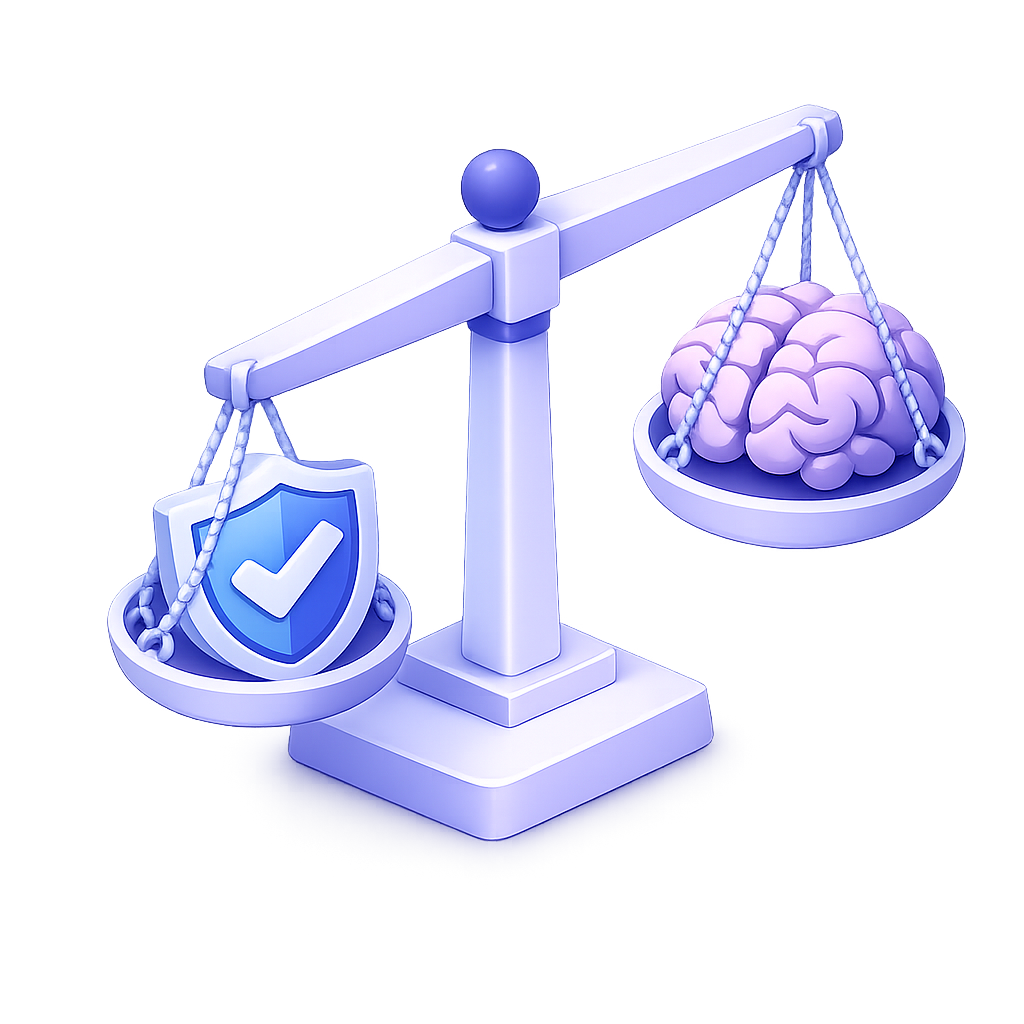
.svg)



I'm sure we've all seen promises like "You can get everything done with the help of AI... AI will take care of everything for you..."
Artificial intelligence (or among friends AI) is indeed transforming compliance work. All the way from drafting policies to analyzing risks, AI tools promise to make compliance faster, easier, and more efficient. Some might even suggest that AI could fully automate compliance. But there’s a problem with that idea.
Compliance isn't just about documentation or checking boxes. Compliance is about accountability, decision-making, and building trust. And these are things that AI just cannot do for you.
What AI is actually good at in compliance
Before we go into the limitations, it’s important to recognize where AI can add value.
AI can significantly improve efficiency in compliance work, especially in areas that involve large amounts of data or repetitive tasks.
AI can help...
...automating repetitive work
- Draft and update policies
- Organize documentation
- Map controls across frameworks
- Summarize requirements
This reduces manual workload and saves time for compliance teams.
...analyzing large datasets
- Reviewing logs and activity data
- Detecting anomalies
- Highlighting potential risks
This allows teams to identify issues faster than manual reviews.
...supporting compliance workflows
- Suggest missing controls
- Highlight gaps in compliance
- Provide recommendations based on best practices
In short, AI helps teams move faster and work smarter.
But speed alone does not equal compliance.
Why AI alone cannot solve compliance
Despite its capabilities, AI has clear limitations when it comes to compliance. While it can support many repetative tasks, it cannot replace the core elements that make compliance to actually work.
Compliance requires accountability
Frameworks like ISO 27001 require clearly defined roles. Someone must approve policies, accept risks, and sign off on outcomes. They are essential parts of demonstrating that the organization takes ownership of its security and compliance.
AI cannot take responsibility for decisions or outcomes. It cannot be accountable if something goes wrong. No matter how advanced the tool is, compliance ultimately comes down to who is responsible, not what tools were used.
Compliance depends on organizational context
Every organization is different and frameworks are not always one-size-fits-all. Not everything is applicable to everyone.
Decisions to what is applicable depend on factors like processes, industry requirements, risk appetite, and maturity level. What is sufficient for one organization may be completely inadequate for another. AI often generates generalized outputs based on patterns rather than your specific context, and without understanding your organization, AI cannot determine what is truly applicable.
However, at Cyberday, we have sought to leverage AI to address this gap. Cyberday’s Fast-track feature creates an ISMS profile for your account, which also enables more personalized outputs tailored to your ISMS implementation.
Risk decisions cannot be automated
Compliance is not a checklist exercise. It is based on risk management.
Two companies may face the same risk but respond differently depending on:
- Business impact
- Available resources
- Strategic priorities
AI can help identify risks and suggest possible actions. But it cannot decide:
- Which risks to accept
- Which controls are sufficient
- What level of risk is acceptable
These decisions require judgment, experience, and an understanding of the bigger picture. In other words, they require humans.
Compliance is about trust and governance
Auditors don’t just look at documentation. Compliance is about showing that the organization operates in a controlled, transparent, and accountable way.
When compliance is assessed, important things are:
- Clear ownerships
- Defined processes
- Evidence of decision-making
- Ongoing governance
AI can generate policies or summarize data, but it cannot demonstrate real commitment, internal accountability, or how decisions are made within the organization.
And we close the circle on what compliance is all about: not just what exists on paper, but how it is managed in practice.
The realistic future: AI + human expertise
The most effective compliance programs are not built on AI alone. AI brings clear advantages. It can automate repetitive tasks, analyze large amounts of data, and improve overall process efficiency. In practice, this means it can:
✅ Speed up documentation
✅ Identify compliance gaps
✅ Analyze data and risks
✅ Support ongoing monitoring
But on its own, that is not enough.
Compliance still depends on human capabilities: making informed decisions, taking responsibility, and ensuring proper governance. These are not something AI can replace, at least in it's current state.
There are also clear boundaries to where AI should be used. While it can support analysis and recommendations, it should not take over core compliance responsibilities:
❌ Make final risk decisions
❌ Replace ownership and accountability
❌ Define governance structures
❌ Fully automate compliance programs
To get real value from AI, organizations should use it strategically. The goal is not to fully automate everything, but to combine AI’s strengths with human judgment and structured processes. We are constantly striving to improve this at Cyberday as well, seeking the best possible combination of AI and human input. as an good example example, Cyberday’s Fast-track feature leverages AI-generated background work to remove generic results, which is then reviewed and validated by a human’s critical eye.
Our goal is to empower compliance teams with real collaboration. At Cyberday, this is exactly the approach we are building towards. AI is used to remove repetitive work and provide smarter starting points like with Fast-track features but always combined with human validation and organizational context.