.svg)


Information security is often built around standards, requirements, and certifications. But while those are indeed important, they don’t automatically lead to good security.
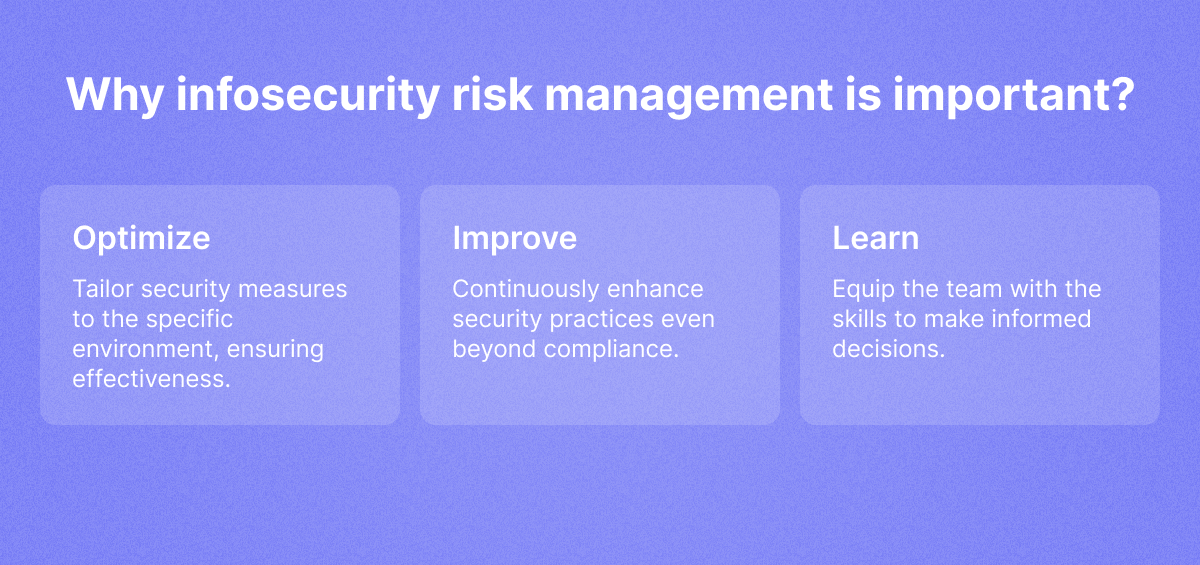
Information security risk management helps organizations go beyond simply “following the standard”. It helps you optimize security for your environment, keep improving over time, and get your people involved in making better decisions.
And to answer to this blog's topic: Risk management makes information security work in real life.
Security standards set the requirements, risk management makes them work
Standards like ISO 27001 define what needs to be addressed, but at the end, they are created as universal and leave the decisions up to you. They can't address your specific systems or what’s most important for your business.
Information security risk management can fill this gap. It helps you decide:
- Which risks are relevant in your environment
- How much protection is enough for different situations
- Where security efforts create real value
Information security risk management helps turn those requirements into practical choices. Without it, security easily becomes classic box-ticking activity. But. with it, security turns into a set of deliberate, well-reasoned decisions that support the organization.
What information security risk management helps you achieve
At its core, infosec risk management supports three closely connected goals. Together, they explain why risk management is such a critical part of effective information security.
Tune your information security to your environment
Security standards give you a framework, but they can’t tell you what matters most for your organization.
Without information security risk management, it’s easy to implement controls just because they’re listed in a standard. With a risk-based approach, you can tune your infosec implementation to your actual systems, data, and ways of working.
Risk management helps you ask:
- What could realistically go wrong for us?
- Which risks have the biggest impact?
- Where should we focus first?
This leads to optimized security where effort is spent on reducing the risks that truly matter.
Keep improving information security after achieving compliance
Achieving compliance, such as ISO 27001 certification, is an important milestone. But compliance alone doesn’t keep your information security effective over time.
Your organization keeps changing: new tools are introduced, responsibilities shift, and new risks emerge. Information security risk management supports ongoing compliance by helping you regularly reassess risks and update controls as your environment evolves.
Instead of treating security as something you prepare only for audits, risk management turns it into a continuous process:
🔎 Risks are reviewed and updated regularly
💼 Controls are adjusted to reflect real changes
🏆 Compliance stays aligned with everyday operations
This way, certification becomes a solid foundation for improvement, not just a once in a while achievement.
Build risk thinking and better decision-making
One of the most valuable outcomes of information security risk management is learning. When risk management involves the people who actually understand the organization, e.g. system owners, process owners, and key decision-makers, it becomes more than a formal exercise. It turns into a shared way of understanding how everyday work, systems, and data relate to information security risks.
Over time, teams begin to think in terms of risks rather than rules. They understand why certain controls exist, learn to compare risks instead of treating everything as equally urgent, and gain confidence in making conscious, informed decisions when trade-offs are needed.
This shared risk understanding strengthens security culture across the organization. It makes security easier to manage, easier to explain, and much easier to follow in practice.
From risk management to better information security
Good information security risk management needs to be practical, continuous, and easy to maintain. If it becomes too heavy or theoretical, it quickly turns into something that’s done once and forgotten. Information security risk management connects standards, people, and everyday decisions. It helps organizations optimize their security implementation, continue improving after achieving compliance, and build long-term risk awareness across the organization.
In Cyberday, risk management is designed to support exactly this. It guides organizations through identifying and assessing information security risks in a structured way, linking risks directly to controls and standards like ISO 27001 aiding multi-compliance and keeping risk management up to date as the organization changes. The process is built to involve the right people without making security work overly technical or time-consuming.
When risk management is done well, information security stops being just an exercise. Instead, it becomes a natural part of how the organization works, supporting better decisions, clearer priorities, and continuous improvement over time.