.svg)



Shall we talk about cybersecurity or information security awareness? On paper, it often looks like organization have cybersecurity awareness covered. They might roll out annual trainings, send few reminder emails, and hope employees remember how phishing can look like six or even 10 months later.
But in reality, incidents do happen, and it's not because employees are not interested or care, but because traditional approaches are simply not sticking so well anymore. Cybersecurity awareness delivered once a year can’t compete with the pace and pressure of daily tasks.
People don’t make secure decisions because they once watched a training video. They make secure decisions when it feels natural in the moment, when the guidance has been proactive and came at the right time, and when security is part of how the whole organization works day to day. That’s the shift we need to make in our work.
Moving away from checkbox awareness programs and toward behavioral security, building a culture where secure habits form gradually, consistently, and with far less friction. Because real awareness isn’t a one-time activity. It’s a collection of small actions that become routines, and eventually, part of your company’s identity.
Why traditional awareness training fails
Security incidents caused by human actions continue to rise, costing organizations financially, operationally, and reputationally. Yet many organizations still rely on the same all too familiar formula: annual trainings, compliance checklists, and generic e-learning. The assumption is simplified: if people complete the training, they’re prepared.
Employees may understand the content in the moment, but when they’re busy or under pressure, those lessons fade quickly. Real decisions happen outside the training room in fast, messy situations where convenience can easily win. That’s why we still see the same issues: reused passwords, skipped updates, quick clicks on suspicious links, and shadow IT used “just to get things done.”
These behaviors aren’t a sign that people don’t care. Most employees genuinely want to do the right thing. They just might need timely guidance, relevant support, and small reminders that fit into their daily work.
The real challenge is making security part of everyday routines, not a once in a long while training event. Effective awareness is about creating an environment where secure choices are easy, expected, and consistently reinforced. Only then does awareness move from theory into practice.

What a security-first culture really looks like
A real security-first culture isn’t built on fear, pressure, or endless reminders. It’s built on an environment where secure behavior feels natural, supported, and expected without adding extra work or slowing people down. In a healthy culture, security blends into everyday routines: the tools people use, the decisions they make, and the conversations happening in the background.
For example, Cyberday reinforces this by helping teams embed security directly into their workflows.
In a security-first organization:
✅ Security fits naturally into everyday workflows.
✅ People feel genuinely responsible for protecting the organization rather than feeling blamed.
✅ Leaders actively model the habits they want others to follow.
✅ Communication happens continuously and in context instead of as a once-a-year event.
5 Practical ways to build cybersecurity awareness
Now that we’ve defined what a security-first culture looks like, here’s how organizations can start building one. Changing behavior isn’t often about doing more but rather about doing things a bit differently. Here are five ways organizations can move from once in a while awareness actions to ongoing, habit-forming support.
1. Make training relevant and role-based
People learn best when the content matches their real tasks. For example in Cyberday, guidance can be tailored to the specific risks and responsibilities each role actually faces, making awareness feel practical and personalized instead of generic. This also opens the door for proactive guidance: employees could receive more personalized tips or reminders when they need them.
2. Move from annual events to ongoing micro-moments
Short, timely interventions work better than long training marathons. Think: case studies, scenario reminders, bite-size tips, or prompts triggered by real behavior.
3. Reinforce behaviors with positive feedback loops
Instead of focusing on what people did wrong, highlight improvements and progress. Habits form faster when people feel they’re succeeding.
4. Embed security into daily tools and workflows
Bring security to where employees already are. Cyberday can be used with Teams and Slack, bringing security tasks directly to the routines, bringing workflows inside the tools people already rely on. No extra portals, apps or friction.
5. Use automation to reduce friction
Automation keeps people on track without manual oversight: reminders, checklists, step-by-step guidance, and tasks that appear right when needed.
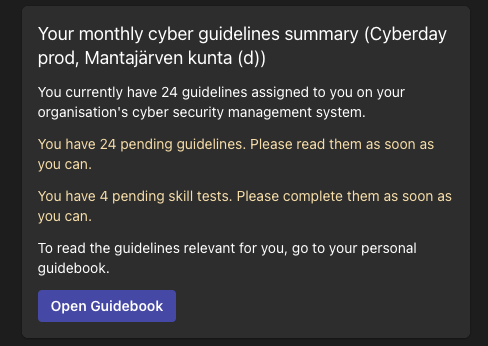
How tools like Cyberday support a security-first culture
Flexible tools such as Cyberday help teams bring cybersecurity awarenes into practice, so teams don’t have to build them from scratch. Cyberday’s role in building a security-first culture is about creating the environment where secure behavior becomes part of everyday work.
Instead of relying on one-off content, Cyberday brings structure, clarity, and timely support directly into the flow of daily tasks so secure choices feel easy and natural.
Cyberday Guidebook + clear guidelines employees actually can understand
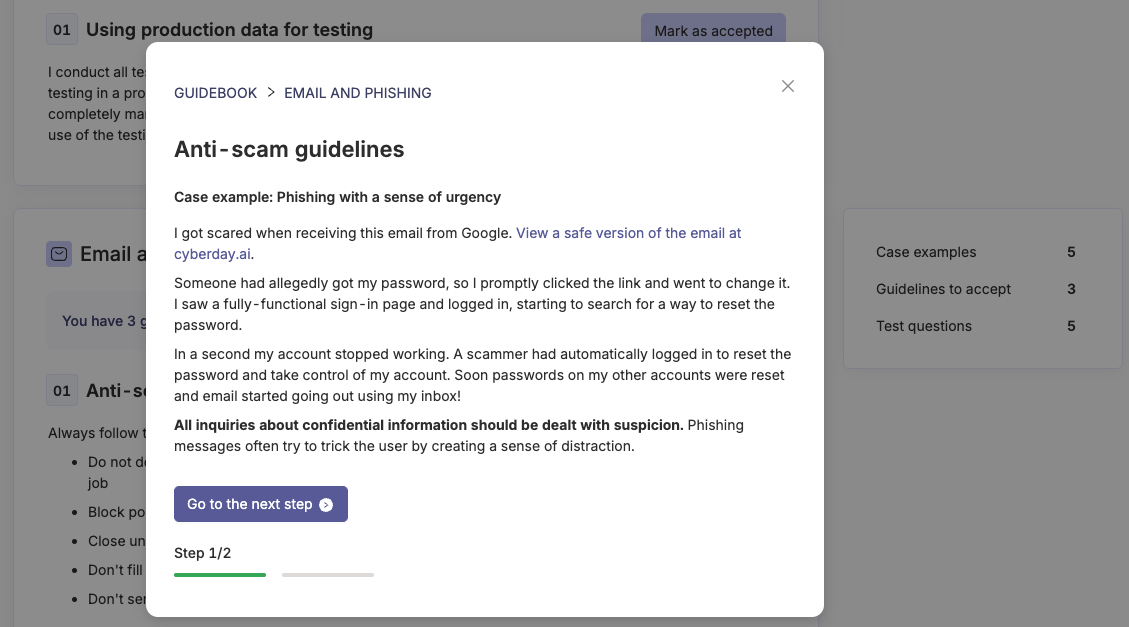
Cyberday gives every employee their own Guidebook - a monitored, personal security manual that includes the guidelines they should follow in everyday work. It keeps expectations clear, accessible, and relevant, so secure behavior becomes part of the routine.
The Guidebook can also include actions that require employee input, such as reporting security incidents or completing specific checks, helping keep everyone aligned and engaged.
Skill tests that reinforce confidence
Lightweight tests help employees validate what they’ve learned and apply it in practice, highlighting strengths and revealing where extra support might help.
Case studies that connect learning to real situations
Realistic examples show how risks and decisions play out in practice, making abstract concepts easier to understand and remember.
Guided task flows
Step-by-step flows make secure actions easy to complete, reducing friction and helping employees build consistent routines.
Integrations in everyday tools
Cyberday delivers guidance and tasks inside the tools people already use like Teams and Slack, keeping security support in the natural flow of work rather than in a separate portal.
Proactive security awareness
Proactive awareness only works if employees know what to do with the information. After highlighting a phishing attempt, non-conformity or news update, reinforce the next step:
Should it be reported and how? What to do? Avoid a tool?
Clear follow-up actions strengthen confidence and reduce hesitation in real moments. Cyberday supports this with guided task flows and simple reporting steps directly in the tools people already use.
Conclusion
For actually making an impact in cybersecurity awareness, we are not interested in just checking boxes, finishing modules, or sending out a reminder once in a while. What does matter is the people and their workflows, decisions, habits, and the small choices they make every single day.
When we shift from compliance-driven training to a culture-led, behavior-focused approach, security stops feeling like separate work and starts becoming part of how the organization operates.
A security-first culture is built in every micro-moment, small decision, and repeated habit. When awareness becomes continuous and contextual, behavior follows and that’s when security truly becomes part of your company’s identity.